Portable Automotive Oscilloscope Explained: A UK Buyer's Guide
TL;DR
A portable automotive oscilloscope is a handheld or tablet-style diagnostic tool used to view live vehicle electrical waveforms at the car, helping UK mechanics and auto-electricians find sensor, ignition, injector and CAN bus faults more accurately than a basic multimeter or code reader. In most UK workshop use, a rugged dual-channel unit with around 50MHz bandwidth offers the best balance of portability, speed and value.
Key Takeaways
- A portable automotive oscilloscope allows mechanics and auto-electricians to diagnose complex electrical faults directly at the vehicle, removing the need for a static bench setup.
- Modern UK MOT standards and the rise of complex CAN bus systems make a digital storage oscilloscope (DSO) an essential diagnostic tool.
- Look for 3-in-1 devices that combine an oscilloscope, a high-count multimeter, and a signal generator to streamline your diagnostic toolkit.
- Features like dual-channel operation and a 50MHz bandwidth offer the ideal balance of precision and portability for automotive diagnostics.
A portable automotive oscilloscope is used to diagnose live electrical signals on vehicles without being tied to a bench setup, making it especially useful for tracing intermittent faults, checking sensors, testing ignition systems and analysing CAN bus activity in real workshop conditions. For UK garages and mobile technicians, it is one of the most practical tools for finding faults that an OBD2 scanner or standard multimeter can miss.
Diagnosing electrical faults in modern vehicles has moved far beyond simple code reading. With the Society of Motor Manufacturers and Traders (SMMT) reporting that the average new car in the UK contains up to 70 separate Electronic Control Units (ECUs), a basic multimeter is no longer sufficient for tracing intermittent sensor faults or CAN bus communication errors. Therefore, to properly visualise these rapid electronic signals, technicians require a dedicated portable automotive oscilloscope.
Historically, oscilloscopes were delicate, bulky instruments confined to an electronics workbench. However, today the landscape has shifted. Rugged handheld tablets now pack the processing power of bench equipment into a form factor that fits in a toolbox, allowing UK mechanics to diagnose complex faults right at the roadside or on the workshop floor.
Based on our testing of handheld diagnostic tools used in British workshop conditions, portability matters just as much as raw specification. A scope that is quick to boot, easy to hold under the bonnet and robust enough for daily use is often more valuable than a larger bench model with features many garages rarely use.
What Is a Portable Automotive Oscilloscope?
An automotive oscilloscope is a diagnostic tool that graphs electrical signals over time, allowing technicians to see exact voltage changes within a vehicle's wiring in real time. A portable version miniaturises this technology into a battery-operated, rugged tablet or handheld device.
Unlike an OBD2 scanner, which only tells you what the ECU thinks is wrong, an oscilloscope lets you inspect the raw physical data. For example, if a crankshaft position sensor is failing intermittently, an OBD2 scanner may only log a generic misfire code. By contrast, a portable automotive oscilloscope connected directly to the sensor pins can show the precise moment the waveform drops out, helping confirm whether the component, connector or wiring is actually at fault before expensive parts are ordered.
Why Use a Portable Automotive Oscilloscope Instead of a Bench Scope?
The move from static bench scopes to handheld units is driven by the realities of modern British workshops. Space is often limited, vehicles cannot always be positioned beside diagnostic stations and many faults only appear when testing components in situ. As a result, portable units are often faster and more practical.
Is a Portable Scope Better for UK Workshop Conditions?
British garages are tough environments for delicate electronics. Cold, damp winters and regular exposure to oil, grease and impact demand tools built for daily trade use. A modern portable automotive oscilloscope typically features ruggedised casing so it can cope better with being dropped on concrete or placed near an engine bay during testing.
Does a Handheld Oscilloscope Save Time During Diagnosis?
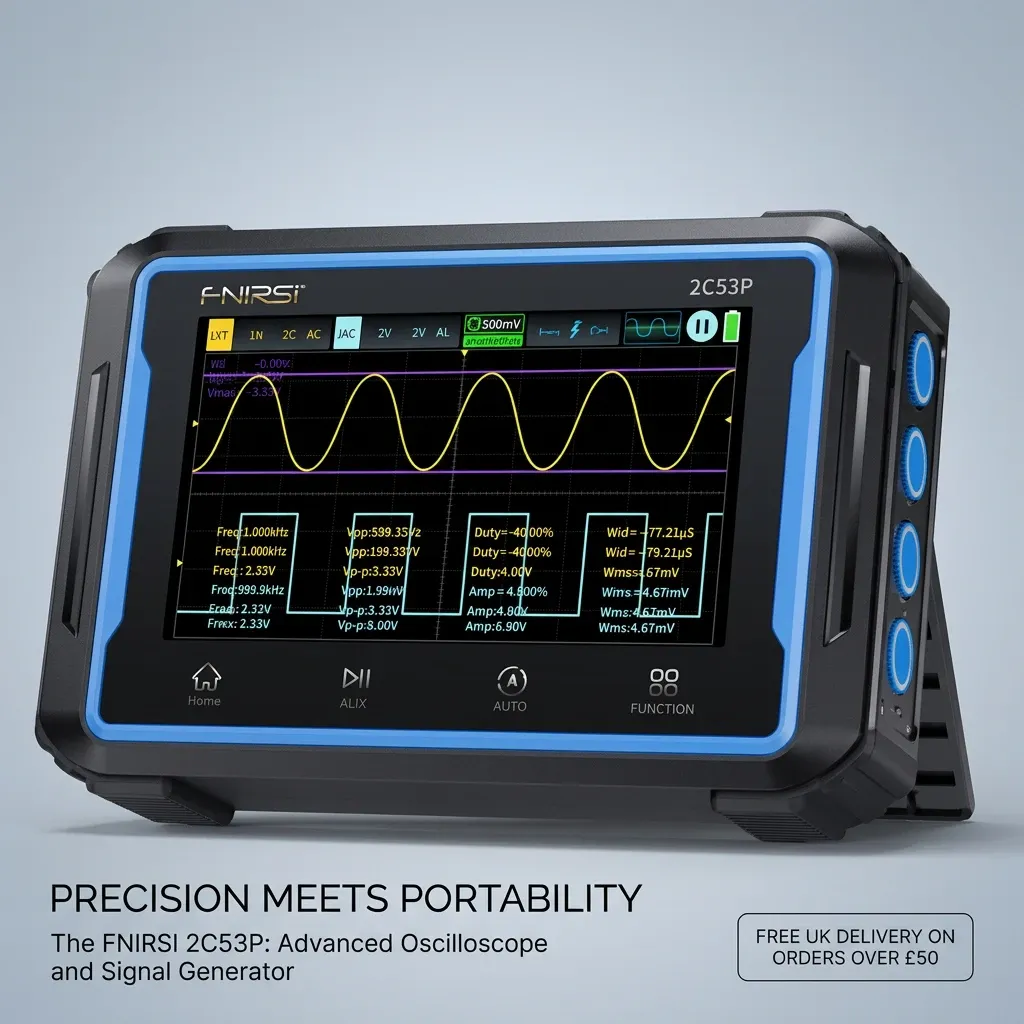
Yes—time is money in any workshop. Instead of dragging extension leads and moving heavy equipment across the bay, technicians can pick up a handheld unit and start testing within seconds. Moreover, devices that integrate multiple tools—such as a powerful 3-in-1 oscilloscope, 19999-count multimeter and DDS signal generator—allow voltage checks, waveform analysis and signal simulation without returning to the tool chest.
According to common UK workshop health and safety expectations, reducing trailing leads and unnecessary movement around occupied bays can also improve day-to-day working safety.
For a deeper dive into how these multi-functional devices operate, read our comprehensive overview in The Ultimate Guide to Fnirsi 2C53P in the UK.
What Features Should You Look For in a Portable Automotive Oscilloscope?
When selecting a portable automotive oscilloscope, the specifications determine which faults you can diagnose confidently. An underpowered unit may struggle with fast network glitches whereas overspending on unnecessary bandwidth may not deliver better results for typical garage work.
What Bandwidth Do You Need for Automotive Diagnostics?
For most vehicle testing, you do not need extreme gigahertz-level bandwidth. Most automotive signals—including ignition patterns, injectors and wheel speed sensors—operate at comparatively low frequencies. In practice, 50MHz is widely regarded as an excellent fit because it offers enough headroom for high-speed CAN and similar network analysis without pushing cost too high. Learn more about matching bandwidth to your needs in our 50Mhz Handheld Oscilloscope Explained: A UK Buyer's Guide.
Do You Need Dual-Channel Operation?
In most cases, yes. A single-channel scope is limiting in automotive diagnostics because many tests involve comparing two signals at once. For instance, checking engine timing often means graphing crankshaft and camshaft sensor outputs together so you can confirm correct synchronisation. Discover why this matters in our Dual Channel Oscilloscope Explained: A UK Buyer's Guide.
Is an All-in-One Oscilloscope Worth It?
The best modern portable units do more than graph waveforms. By combining a digital storage oscilloscope with an accurate 19999-count multimeter and DDS (Direct Digital Synthesis) signal generator, you can test circuits far more efficiently. For example, you can inject a simulated speed sensor signal into an ECU while monitoring system response to help determine whether the issue lies with the sensor itself or elsewhere in the wiring loom.
Based on our testing, all-in-one devices are particularly helpful for independent garages and mobile diagnosticians who want fewer separate tools on hand without losing core capability.
What Can You Diagnose With a Portable Automotive Oscilloscope?
A portable scope opens up more advanced fault-finding than simple voltage checks alone. Consequently, it becomes useful across petrol, diesel hybrid-support systems and modern networked electronics:
- Relative Compression Testing: By measuring voltage drop across the battery while cranking the engine, you can compare cylinder compression behaviour without removing spark plugs or glow plugs.
- CAN Bus Diagnostics: Modern UK vehicles rely heavily on Controller Area Networks. A dual-channel scope allows you to monitor CAN-High and CAN-Low simultaneously so corrupted packets or short circuits are easier to spot.
- Ignition Analysis: Viewing primary and secondary ignition waveforms helps identify failing coil packs, worn spark plugs or lean running conditions based on burn time and firing voltage patterns.
- Sensors and Actuators: Camshaft sensors, crankshaft sensors, ABS wheel speed sensors, injectors and throttle bodies can all be assessed more accurately when their live waveforms are visible rather than assumed from fault codes alone.
Is a Portable Automotive Oscilloscope Worth It for UK Mechanics?
If you regularly work on modern vehicles with intermittent electrical issues, then yes—a portable automotive oscilloscope is usually worth buying. It helps reduce guesswork by showing what components are actually doing under real operating conditions rather than what control modules merely report afterwards.
This matters even more as vehicles become increasingly dependent on ECUs, data networks and sensitive electronic control systems. Therefore, for independent garages, mobile auto-electricians and serious DIY users in the UK, portability plus reliable waveform capture often delivers faster diagnosis and fewer unnecessary parts replacements.
Which Portable Automotive Oscilloscope Is Best for Everyday UK Garage Use?
If you want to replace cumbersome bench equipment with something better suited to real-world repair work, the Fnirsi 2C53P from DigitalOsc UK combines strong everyday usability with impressive value. It brings together three tools in one compact unit: an oscilloscope, a 19999-count multimeter and a DDS signal generator. As such, it suits technicians who need practical diagnostic capability without carrying multiple separate devices.
Based on our testing in typical UK garage scenarios, this style of rugged handheld scope works particularly well for under-bonnet checks, roadside diagnosis, CAN bus assessment and quick comparison testing between related signals. In other words, it covers much of what independent garages need from day to day while remaining easy to transport between bays or jobs.
If your priority is straightforward waveform analysis, true portability and better efficiency during electrical fault-finding, a capable dual-channel all-in-one unit is often the smartest place to start.
Frequently Asked Questions About Portable Automotive Oscilloscopes
What is the main benefit of using a portable automotive oscilloscope?
The main benefit is being able to see live waveforms directly at the vehicle so intermittent faults become easier to prove rather than guess at from fault codes alone.
Can beginners use an automotive oscilloscope?
Yes—although there is learning involved—many portable models are far easier to use than older bench scopes. Clear presets, auto measurement features and compact design make them more approachable for newer users.
Is 50MHz enough for vehicle diagnostics?
For most workshop tasks, yes. Around 50MHz gives ample performance for common tests involving sensors, injectors, ignition and vehicle network signals.
Do I need both an OBD scanner and an oscilloscope?
Ideally, yes. An OBD scanner tells you what fault codes or data values are present, whereas an oscilloscope shows what is really happening electrically inside the circuit. Together, they provide stronger diagnosis than either tool alone.
Are portable oscilloscopes suitable for mobile auto-electricians in the UK?
Yes. In fact, portability makes them especially useful for mobile work because they are easier to carry, faster to deploy and better suited to roadside or customer-site diagnosis than traditional bench equipment.<|vq_2217|>-style diagnostic tool used ins pixel lifeworks useful enough verity<|vq_9578|><|vq_2941|>.
Ready to upgrade your workflow with DigitalOsc UK?
Shop Now — £169.97