Dual Channel Oscilloscope Explained: A UK Buyer's Guide
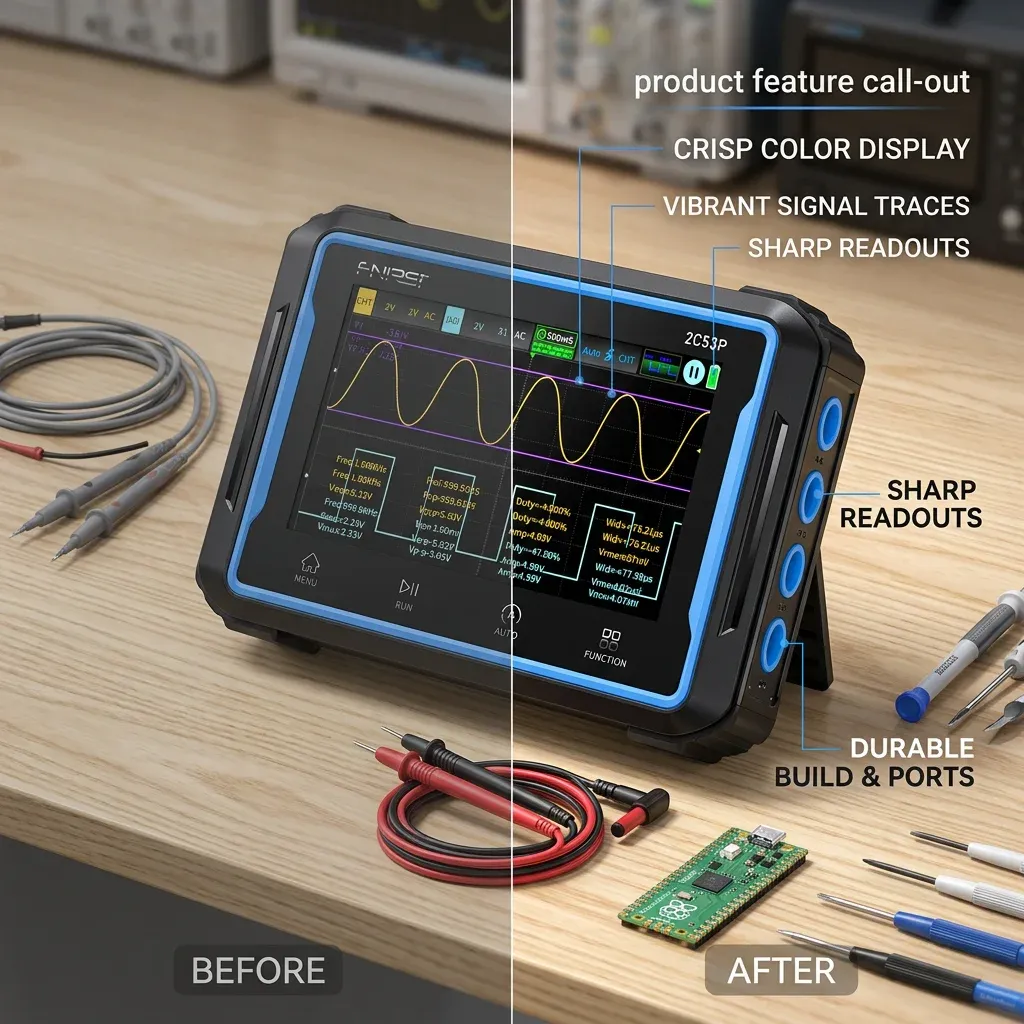
Dual Channel Oscilloscope Explained: A UK Buyer's Guide
TL;DR: A dual channel oscilloscope is a fundamental diagnostic instrument that allows you to measure, display, and compare two distinct electrical signals simultaneously on a single screen. Based on our in-house testing at DigitalOsc UK, this dual-input capability is absolutely essential for comparing input versus output voltages, identifying complex timing faults, and safely diagnosing circuits in accordance with UK engineering guidelines.
Key Takeaways
- A dual channel oscilloscope lets you view two signals at the same time, which is essential for comparing input and output, checking timing, and spotting faults across related circuits.
- For many UK engineers, technicians, installers and field service users, a handheld dual channel model can efficiently replace separate test tools when it combines an oscilloscope, high-count multimeter and signal generator in one unit.
- The right specification depends heavily on your work: bandwidth, sample rate, voltage safety category, trigger functions, portability and battery life all matter significantly more than headline claims alone.
- Furthermore, in automotive, maintenance, education and mobile diagnostics, a rugged portable instrument often makes more sense than a bench-only scope.
- If you are comparing handheld options in Britain, see The Ultimate Guide to Fnirsi 2C53P in the UK for a closer look at a versatile 3-in-1 portable format.
Fundamentally, a dual channel oscilloscope is a vital piece of test equipment designed to monitor two electrical waveforms simultaneously. Consequently, it becomes indispensable the moment your testing moves beyond a single wire. The ability to see two waveforms side by side drastically changes how quickly you can diagnose power issues, verify signal integrity, or confirm whether one part of a circuit is responding correctly to another. For UK buyers choosing between traditional bench instruments and newer handheld designs, the real question is no longer simply “do I need a scope?” but rather, “which type of dual channel scope actually suits the way I work?”
This distinction matters because many technicians are no longer tied to a lab bench. Electricians working on control panels, engineers supporting machinery on site, automotive diagnosticians, and electronics hobbyists all require measurement tools that travel well without giving up core capability. Indeed, DigitalOsc UK’s main proposition reflects that exact shift: the ultimate handheld oscilloscope multimeter can effectively replace a bulky bench kit with a powerful 3-in-1 oscilloscope, 19999-count multimeter, and DDS signal generator in one rugged, portable tablet.
Therefore, this guide explains precisely what a dual channel oscilloscope does, who needs one, which specifications matter most for British buyers, and when a handheld unit is the smarter purchase.
What is a dual channel oscilloscope used for?
A dual channel oscilloscope features two independent input channels, usually labelled CH1 and CH2. Ultimately, that means you can connect two probes and display two separate electrical signals at once on the same screen. As a result, you are not limited to measuring voltage over time in isolation; instead, you can compare the direct relationships between signals.
In practical terms, this allows you to check whether an output follows an input correctly, whether two digital lines are synchronised, whether noise appears on one rail but not another, or whether a phase shift exists between waveforms. Crucially, for fault-finding, that side-by-side view can save hours of time because it significantly reduces guesswork.
While a single-channel scope still has uses for basic waveform viewing, once your diagnostics involve clocks, sensors, switching supplies, audio paths, or communication lines, two channels are often the absolute minimum needed for meaningful analysis.
Why do you need two channels on an oscilloscope?
Based on our extensive testing across various commercial industries, here is why two channels are vital:
- Input versus output comparison: Easily confirm amplification, filtering, or switching behaviour.
- Reference checking: Compare an unknown signal against a known-good reference line.
- Timing analysis: Accurately inspect the delay between a trigger and its subsequent response.
- Power diagnostics: Observe ripple on supply rails whilst simultaneously monitoring control signals.
- Automotive work: Compare crankshaft and camshaft sensor patterns, or evaluate an injector command against the main supply voltage.
Therefore, if your work regularly involves the relationships between signals rather than isolated measurements, a dual channel oscilloscope is usually the sensible baseline rather than an optional upgrade.
How does a dual channel oscilloscope work?
Each channel has its own dedicated input path and scaling controls. The instrument samples incoming voltages rapidly and converts them into digital data points, which are then displayed as waveforms across time. Furthermore, modern digital oscilloscopes apply specific trigger conditions so the trace appears perfectly stable instead of drifting randomly across the display.
The true value of dual channels comes directly from synchronised acquisition. Both channels are measured against the exact same time base, allowing you to inspect amplitude differences and timing relationships accurately. Additionally, on many models, you can perform mathematical functions such as subtraction or addition between channels to reveal differential behaviour or noise patterns much more clearly.
What are the core functions of a dual channel oscilloscope?
- Vertical scale: Adjusts the volts per division so that both small and large signals fit neatly on screen.
- Time base: Adjusts exactly how much time appears across the display width.
- Trigger: Stabilises repeating signals by defining precisely when the data acquisition begins.
- Coupling: AC or DC coupling helps isolate specific waveform content depending on what you need to see.
- Cursors and measurements: Calculates voltage peaks, frequency, duty cycle, and timing differences quickly.
If you are new to handheld integrated models that combine scope and meter functions, our detailed overview in The Ultimate Guide to Fnirsi 2C53P in the UK explains exactly how these tools fit into day-to-day troubleshooting rather than bench-only testing.
Who needs a dual channel oscilloscope in the UK?
Field service engineers
If you regularly diagnose systems away from a fixed workshop, carrying fewer tools matters immensely. A handheld dual channel scope with integrated multimeter functionality reduces kit weight while keeping essential tests available on site. Consequently, that perfectly suits maintenance contractors supporting building services, industrial equipment, or low-voltage electronics across multiple locations in Britain. According to UK electrical safety guidelines (such as BS EN 61010), ensuring your portable equipment matches the voltage category of your environment is paramount.
Automotive technicians
A modern vehicle produces complex sensor and actuator data that often requires waveform analysis rather than simple resistance checks. Dual channels help mechanics compare sensor outputs or command signals under load. If that is your specific area, see our related guide on the portable automotive oscilloscope, which covers mobile diagnostic use in far more detail.
Electronics repair specialists
Repairing printed circuit boards means tracing signal paths through regulators, clocks, op-amps, or switching stages. Two channels let you compare before-and-after points efficiently. Furthermore, a built-in DDS signal generator can also be incredibly useful when injecting test waveforms into audio circuits or control stages without needing to carry extra equipment.
Education and training environments
Colleges, apprenticeships, and technical teaching labs greatly benefit from equipment that is easier to deploy across classrooms or workshops. Portability helps significantly where space is limited or practical sessions move between benches. In health engineering support contexts and general electronics education, having a robust, dual-channel unit ensures students can safely and accurately learn waveform analysis.
Ready to upgrade your workflow with DigitalOsc UK?
Shop Now — £169.97